
About the Author
Samad Rafe is the author; he is the Founder of Darul Arqam Center of Excellence, and a former President of the McKinney Islamic Association, and has served on masjid shura boards for over 10 years. As a serial tech entrepreneur and longtime community leader, he writes from direct experience inside the governance and leadership challenges facing American masajid.
A Meeting That Said It All
I remember a board meeting a few years back. On the surface, it was normal, agenda, reports, the usual back-and-forth. But then the discussion turned to the imam. Not his sermons. Not the new youth program he wanted to start. Not the counseling load he was carrying.
The question on the table was: “How many hours is he physically in the building?”
I sat there, listening to smart, successful people, doctors, engineers, entrepreneurs- debate whether they could “require” him to be onsite more, and why he wasn’t there on a random Tuesday night. It felt surreal. We were managing a scholar, a spiritual guide, the inheritor of Prophetic knowledge, like a part-time shift supervisor at a store. We were counting hours when we should have been counting transformed lives.
That moment crystalized a quiet crisis I’d felt for years but hadn’t named. In our well-intentioned efforts to build professional, sustainable institutions, we’ve accidentally imported a corporate mindset that is slowly suffocating the spiritual heart of our communities. We are managing the carriers of sacred knowledge like employees, evaluating them on visibility and compliance, and then we act shocked when our religious education feels shallow, our youth drift away, and our mosques become beautiful, empty shells.
Allah asks in the Quran in Surah Az-Zumar:
قُلْ هَلْ يَسْتَوِي الَّذِينَ يَعْلَمُونَ وَالَّذِينَ لَا يَعْلَمُونَ ۗ إِنَّمَا يَتَذَكَّرُ أُولُو الْأَلْبَابِ
Translation :
“Say, ‘Are those who know equal to those who do not know?’ Only those who have understanding will take heed.” (39:9)
He tells us He raises in rank those who have been given knowledge. Yet, in our practical governance, we often do the opposite. Through micromanagement, misplaced metrics, and a focus on facility over faith, we systematically lower the rank of our scholars within the very institutions built to elevate knowledge. If we persistently disrespect the vessel, should we be surprised when the water of guidance runs dry?
The Story That Should Terrify Us All
Let me tell you a story I can’t forget. It’s the story of what we lose when we get this wrong.
A few years ago, a masjid in the Dallas-Fort Worth area brought on an imam who was a genuine scholar. We’re talking PHD-level expertise in Quranic sciences and theology, educated from the trenches of Gaza, a man who had depth in his bones. He wasn’t the flashy, fundraiser type. He wasn’t the most polished public speaker. His strength was in the quiet, patient work of transformation.
He built a Quran program for the kids that wasn’t about force or fear, but about love and connection. He quietly started mentorship circles for teenagers who were otherwise only seen at the masjid for Eid prayers. He talked to them about identity, purpose, and adab, Islamic manners that go deeper than just ritual. Parents came to board members with tears in their eyes, saying, “My son finally wants to pray. My daughter is reading the Quran on her own. We have our child back.”
But inside the president’s office, the conversation kept returning to one thing: hours. The refrain was simple—“full-time hours for full-time pay.” The transformation taking place in the youth, the strengthening of families, the consistency of Qur’an circles—those were treated as “nice to have,” not as the standard by which the imam was evaluated. The real scorecard was visibility and time in the building. And rather than a community-wide process—parents, students, and stakeholders being consulted—the decision was ultimately made at the top.
Over time, the pressure mounted. The scholar was let go; the contract was not renewed. And the most painful part is that this happened while he was personally carrying immense grief—having lost 16 members of his family in Gaza Genocide in recent months. Whatever one thinks about governance, a community should never lose its basic humanity.
Let that sink in. A community was given a gift, a person capable of building resilient, God-conscious young Muslims, of stopping the generational drift in its tracks and they handed that gift back. They traded a transformer of souls for the comforting predictability of a timecard.
The message this sends is deafening: In many of our masajid, your value is not measured by the deen you build, but by how visibly you perform labor under someone’s supervision. When that becomes the culture, the outcome is a foregone conclusion. The deep, thoughtful scholars leave, or are never hired in the first place. What remains are those who can play the game, who look the part, please the donors, and stay visibly busy. The education of our children collapses into entertainment and daycare. And we inherit masajid that are masters of raising funds, but have forgotten how to raise Muslims.
The Pain We Feel But Don’t Name: Four Broken Pieces
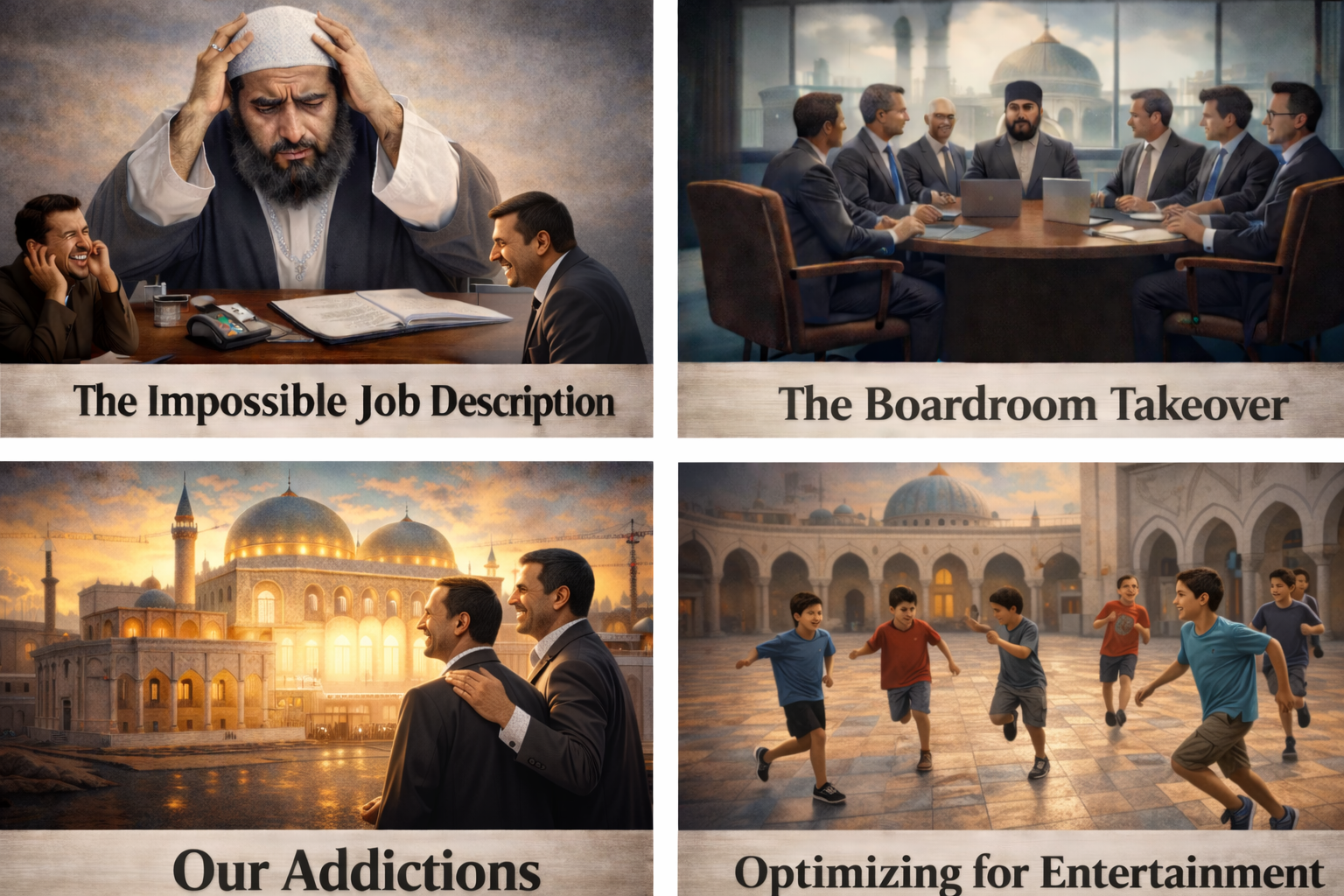
This crisis manifests in a few specific, aching ways:
1. The Impossible Job Description.
We have turned the role of ‘imam’ into a cruel joke. One human being is now expected to be: a flawless prayer leader (with good tajweed), a weekly orator (khutbahs that are both profound and engaging), a family crisis counselor (for marriage, divorce, and teen rebellion), a conflict mediator, a mandatory attendee at all committee meetings, the public face of the community to media and other faith groups, the lead fundraiser at banquets, the youth director, the volunteer coordinator, and a 24/7 on-call spiritual emergency service.
And then we evaluate him on “Why wasn’t he at the potluck?” or “He seems quiet in meetings.” We’ve created a role designed for burnout and then blame the individual when they crack. This isn’t leadership; it’s institutionalized disrespect with a religious veneer.
2. The Boardroom Takeover of Religious Authority.
Our shura members are often the most successful among us, surgeons, CEOs, software architects. We are deeply grateful for them. They bring operational excellence, financial acumen, and project management skills we desperately need. The problem arises when the framework of their professional world becomes the only framework for running the masjid.
These brothers and sisters know how to optimize for efficiency, ROI, and liability reduction. But spiritual growth is inefficient. The ROI of a child’s love for Quran shows up over 20 years, not on the next quarterly report. You cannot mitigate the “liability” of a deep, challenging sermon that might offend a major donor.
So, unconsciously, boards optimize for what they understand: building usage schedules, event headcounts, policy manuals, and fundraising targets. Religious education becomes just another “program” to be managed, its budget the first to be cut, its outcomes the hardest to quantify. The scholar becomes a “program manager” reporting to a board of directors who, despite their best intentions, may have little literacy in what scholarship actually requires: deep reading, contemplation, curriculum design, and the long, slow, unseen work of tarbiyah (nurturing).
3. Our Addiction to Bricks and Titles.
Let’s be honest: expansion is seductive. A new wing, a bigger dome, a state-of-the-art gym, these are tangible, legacy-defining achievements. There is real barakah (blessing) in providing space for worship. But when a community’s vision narrows to “raise money, build, repeat,” the masjid subtly shifts into “facility-first” mode. The board’s focus becomes dominated by contractor meetings, loan refinancing, and capital campaigns.
In this environment, leadership positions become attractive for reasons other than service. They come with influence over millions of dollars, social status, and control. Slowly, insidiously, the building becomes the mission. We are building monuments, not movements. And our youth, with their keen noses for hypocrisy, see it clearly. They see the gala dinners for the new minaret while their Quran class teacher is of no importance.
4. Optimizing for Entertainment, Losing Our Children.
This one is personal. I have a 13-year-old son. Over the years, I’ve watched him cycle through “youth activities” at various masajid. Too often, there are exercises in creative babysitting: pizza, video games, basketball, maybe a 5-minute “Islamic reminder” squeezed in. They are, in essence, “a hangout spot at the masjid instead of the mall.”
There’s little structured learning, no graduated curriculum, and no clear pathway from “attendee” to “student” to “young leader.” The unspoken KPI (Key Performance Indicator) is “youth turnout.” A successful event is one where the parking lot is full of teens.
Let me be fair: fun is not the enemy. Entertainment can be a powerful gateway. A fun night is brilliant, if it is a deliberate, strategic funnel. If the goal is to get a teen’s phone number, follow up, and invite them to a serious weekly halaqah on iman (faith) or Seerah. If the basketball game is preceded by a 30-minute workshop on discipline in the life of the Prophet ﷺ.
But when the fun is the end goal, we produce a generation that is socially attached to the masjid but religiously shallow. They have Muslim friends and eat halal pizza together, but their understanding of Allah, their relationship with the Quran, and their commitment to the sunnah remain underdeveloped. We’ve made Islam a social identity, not a transformative belief system.
What Islam Actually Teaches About Scholars
This isn’t just a management dispute. Framing it as “imam-board tension” minimizes it. This is about the structural foundations of our community’s survival.
The Prophet Muhammad ﷺ said, “The scholars are the inheritors of the prophets.” (Sunan al-Tirmidhī) This isn’t a nice honorific. It’s a job description with cosmic implications. The prophets left no dinars or dirhams; they left knowledge. The scholars are the trustees of that inheritance. If we mismanage, disrespect, or drive away the trustees, we break the chain of transmission. The inheritance is lost.
He ﷺ also said, “Whoever treads a path in search of knowledge, Allah will make easy for him a path to Paradise.” (Sahih Muslim) And, “The best of you are those who learn the Quran and teach it.” (Sahih al-Bukhari)
Our institutions should be the embodiment of these priorities. When they are not, when they prioritize the manager over the teacher, the fundraiser over the mentor, we are engaged in a slow-moving institutional suicide. We are weakening the very engine, knowledge transmitted with wisdom and love, that produces grounded, confident, contributing Muslim humans.
Navigating the Necessary Tensions: Two Truths to Hold at Once
To avoid caricature, we must hold two truths in balance:
- Truth One: Boards can and should demand professionalism.
Some imams have real gaps. Poor organizational skills can cripple a community. Weak communication, especially in a Western context, can create distance. A lack of effort to understand local American challenges, the mental health crisis, the public school environment, the legal system, can make advice feel irrelevant. A failure to connect authentically with youth is a serious deficit. These are real issues that need to be addressed with clarity, compassion, and structured support.
- Truth Two: Scholars are not corporate employees, and you cannot fix spiritual gaps with corporate tools.
You do not fix a lack of pastoral skill by demanding more hours in the office. You do not build a scholar’s connection to American youth by humiliating him in a meeting. You do not deepen Islamic literacy by tying his performance review to fundraising metrics.
You fix these gaps with role clarity, mentorship, and professional development rooted in the mission. You partner a young imam with a respected, locally-rooted elder for guidance. You provide funds for him to take courses in counseling or public speaking. You protect his time so he can actually visit schools, meet with non-Muslim leaders, and understand his community. You build a team around him, youth directors, counselors, Quran teachers, so he is not a lone, drowning figure.
Deconstructing the Common Complaints
Let’s apply this balance to the complaints we often hear in boardrooms:
“Foreign-educated imams don’t understand our local issues. They bring cultural baggage.”
This is sometimes true. America presents unique fitan (trials): navigating Muslim identity in a secular culture, drug and alcohol pressures in schools, social media’s toxicity, the breakdown of the family. An imam from a traditional village context may need a deliberate orientation.
But what is the board’s responsibility? Do they provide a structured, paid 90-day onboarding with community introductions? Do they pair him with a “cultural mentor”? Do they carve out time in his first year specifically for him to learn, rather than perform? Or do they just throw him into the deep end and then complain he can’t swim?
And let’s be brutally honest: many of the brothers leveling this complaint are themselves foreign-educated professionals (doctors, engineers) who succeeded in America while carrying their own cultural baggage into their parenting, their marriages, and their boardroom politics. The demand for adaptation cannot be a one-way, arrogant street.
“Bad English and weak organizational skills.”
Communication matters. Professionalism matters. An imam who cannot communicate effectively with the next generation is handicapped.
But too often, “English” is used as a code word for something else. It can mean: “Keep your sermons light and inspiring. Don’t challenge us on our sins. Don’t talk about politics or money in a way that makes donors uncomfortable. Be a performer.” The masjid starts to reward stage presence over spiritual depth, charisma over character. We end up with motivational speakers, not scholars. And then we wonder why our children’s Islamic knowledge is a mile wide and an inch deep.
“We need local, homegrown scholars.”
Yes. A thousand times, yes. This is the ultimate goal.
But local scholars do not materialize because boards complain about accents. They are cultivated through a 10-to-20-year pipeline that the community must intentionally build and fund. This pipeline includes: rigorous weekend and summer schools, scholarship funds for serious Islamic university studies, teacher development programs, and creating respected, sustainable career paths for educators within our institutions.
Local scholars come from youth who are trained, not just entertained. They are the products of the very system we are currently neglecting.
Salary Isn’t Respect. The Scorecard Is Respect.
Many communities believe showing respect means paying a high salary. Certainly, paying a fair, dignified wage that allows an imam to own a home and send his kids to college is a fundamental Islamic obligation. But money alone is not respect.
True respect is what you choose to measure.
If you pay an imam $100,000 a year but measure his success by his hours logged, his attendance at social events, and his ability to deliver a rousing fundraising pitch, you are still treating him like a highly-paid employee. You are saying, “Your value is in your utility to our institutional needs.”
I’ve seen this play out over a decade on various shuras. The imam who is a gifted orator and fundraiser receives endless praise, budget increases, and leeway. The imam who is a quiet, meticulous teacher, who transforms children but doesn’t electrify banquets, is often sidelined, his programs underfunded, his contributions subtly minimized.
The silent message to the entire community, especially the youth, is corrosive: “What we truly value is what brings in money and applause, not what builds your soul.” That single, misaligned incentive can hollow out a community over a generation.
The KPI Reset: What to Measure If You Want to Survive
Our key performance indicators create our reality. If we measure the wrong things, we will succeed brilliantly at the wrong mission.
If your masjid’s KPIs are:
- Hours the imam is in the building
- Attendance numbers at Friday prayer
- Khutbah “approval ratings” or popularity
- Funds raised at the annual dinner
- Number of social events hosted
- Volume of complaints handled (or suppressed)
…then you will produce: A community focused on optics, burnout, donor appeasement, and shallow engagement. You will have a bustling building full of religious consumers.
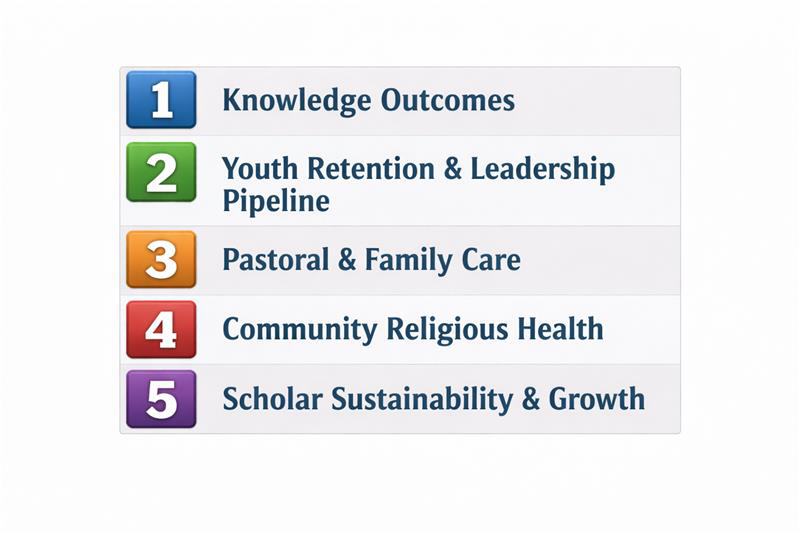
If you want generational survival, measure the work of an educator and spiritual shepherd:
Knowledge Outcomes:
- Existence of a structured curriculum with clear pathways (e.g., “New Muslim 101” → “Foundations of Fiqh” → “Advanced Aqidah”).
- Program completion rates (not just sign-ups).
- Consistency and longevity of core classes (e.g., a weekly Seerah class that runs for 12 months, not 4 weeks).
Youth Retention & Leadership Pipeline:
- Returning youth rate: How many teens come back week after week? (Retention > One-Time Turnout).
- Number of active, small-group mentorship circles with stable, trained mentors.
- A clear pipeline: Attendee → Committed Student → Volunteer Teacher’s Aide → Program Leader.
Pastoral & Family Care:
- Reasonable response time for urgent pastoral cases (death, crisis, marriage conflict).
- Follow-up consistency for ongoing counseling.
- Reach of proactive family education (e.g., number of couples completing premarital counseling).
Community Religious Health:
- Stability and depth of ongoing halaqas (study circles) and Quran programs.
- Observable growth in community adab (manners), worship, and mutual support.
Scholar Sustainability & Growth:
- Protected, uninterrupted time for study and khutbah preparation (e.g., 10 hours/week minimum).
- A funded professional development plan (conferences, courses).
- Clear workload boundaries to prevent burnout (e.g., one day off consistently, limited evening meetings).
The Model: Two Protected Lanes, One Road
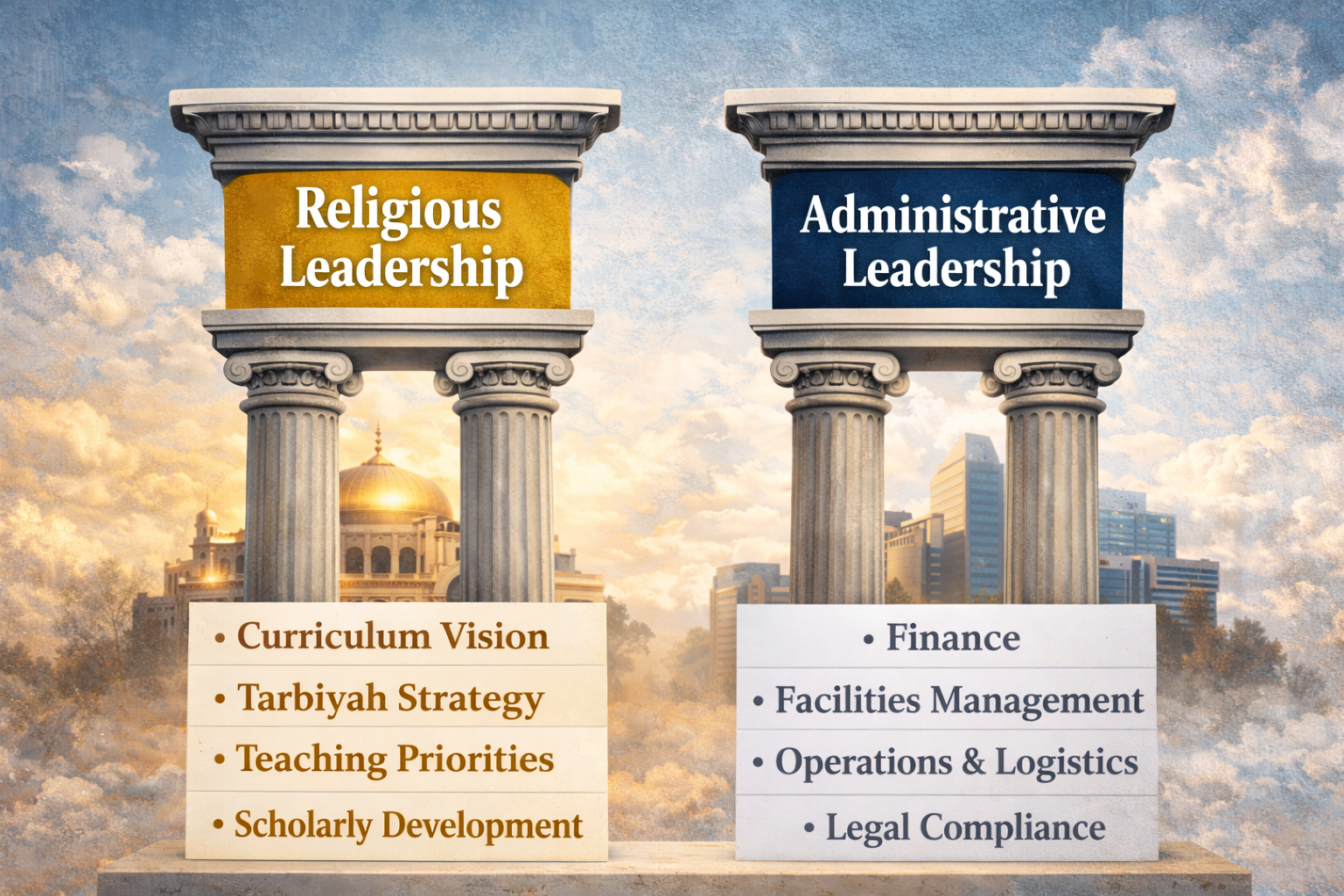
A healthy, sustainable masjid operates with two distinct but synchronized lanes:
- Lane of Administrative Governance: Finance, legal compliance, facilities management, operations, event logistics, strategic planning. This lane is accountable for stewardship, efficiency, and sustainability.
- Lane of Religious Leadership & Education: Curriculum vision, tarbiyah strategy, teaching priorities, spiritual care standards, scholarly development. This lane is accountable for spiritual and educational outcomes.
The board primarily operates and is expert in Lane 1. Its primary duty regarding Lane 2 is not to drive it, but to enable it, protect it, and resource it. The scholar leads Lane 2. He is consulted on how Lane 1’s decisions affect the spiritual mission. There is a partnership of respect, with clear boundaries. The board does not dictate sermon topics. The scholar does not unilaterally approve construction contracts.
A Call to Action: This Year, Not “Insha’Allah”
This is not a theoretical discussion. Our children are growing up now. The drift is happening now.
If you are on the board this year, commit to these four actions:
1. Rewrite the Imam’s Role Description. Model it after a university professor or a nonprofit CEO, not an hourly worker. Define success by the outcomes in the “KPI Reset” above. Grant explicit authority over the educational and spiritual domain. Guarantee in writing, protected, uninterrupted preparation time.
2. Publish and Pursue the Right Metrics. Start your next board meeting by reviewing the “Knowledge Outcomes” and “Youth Retention” data, not just the financials. Make this the heart of your reporting.
3. Build the Youth Funnel with Purpose. Mandate that every “fun” youth event have a clear next step, an invitation to a structured learning program. Fund and staff the learning programs as seriously as you fund the fun.
4. Fund Knowledge Like You Fund Concrete. If you can raise $2 million for a new wing, you can allocate $200,000 for a full-time youth director, curriculum materials, teacher training, and scholarships for advanced Islamic studies. Make it a line item in your capital campaign.
If you are a community member:
1. Stop Rewarding Fundraising Charisma. Applaud the teacher. Thank the quiet mentor. Donate specifically to educational programs.
2. Stop Accepting “Youth Nights” as Enough. Ask your board: “What is the learning pathway this is funneling into?” Demand transparency on educational goals.
3. Vote with Your Wallet. Support leaders who demonstrate Islamic literacy, humility, and a vision for nurturing people, not just expanding property. Run for the board yourself if you have this vision.
The crisis is quiet, but it is real. We are at a crossroads. We can continue to build larger, emptier monuments to our success. Or we can choose to build deeper, anchoring our communities in the knowledge and love that alone can hold the next generation through the storms of this world.
The choice is ours. Our children are waiting to see what we value. Let’s show them it’s their souls, not just our structures.